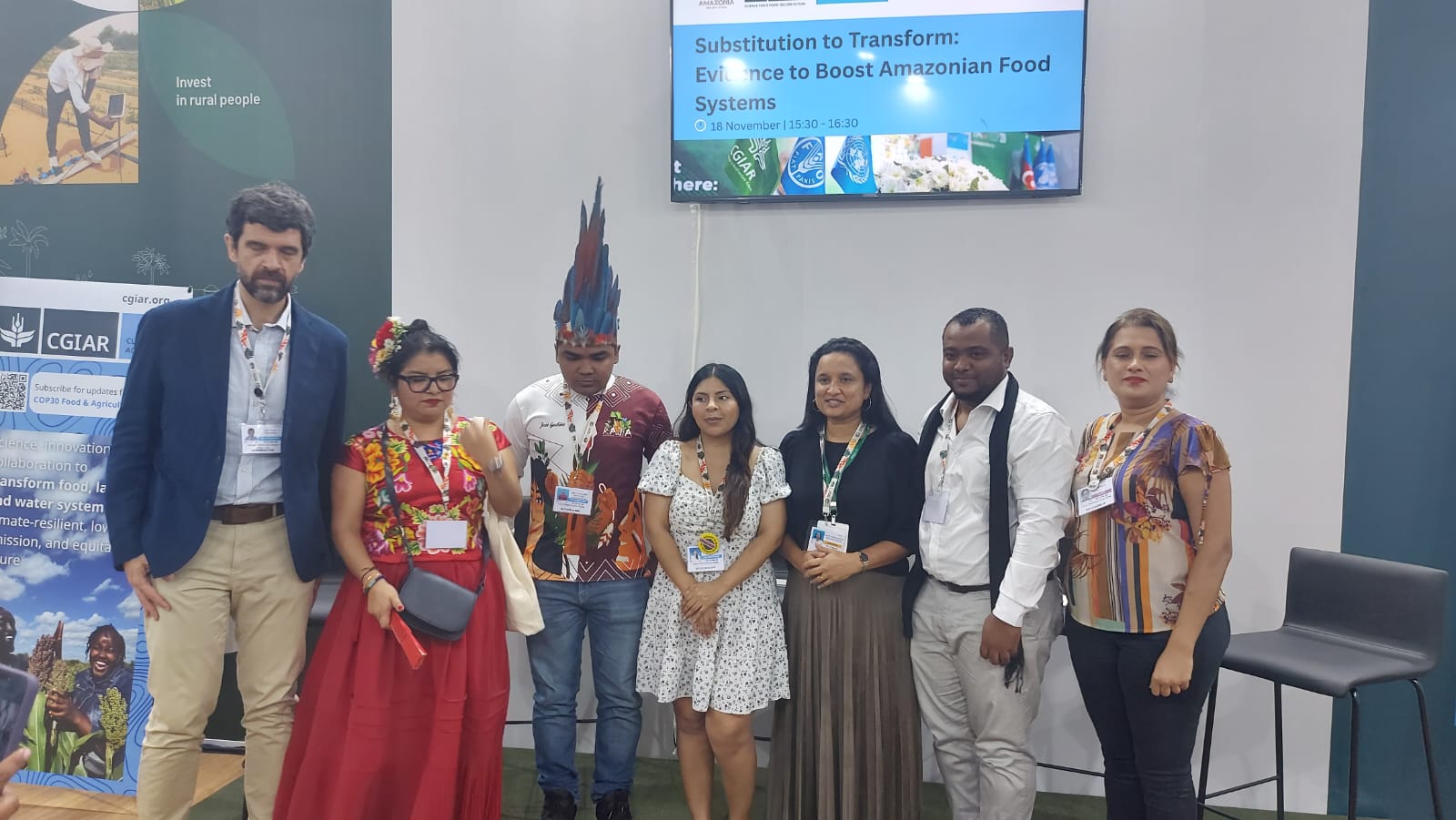
Belém, November 18, 2025 – As part of COP30, the Amazon Cooperation Treaty Organization (ACTO) held today the event “Substituting to Transform: Evidence to Boost Amazonian Food Systems“. The session took place at the World CGIAR, Food and Agriculture Pavilion in the Blue Zone, where experts and representatives of Indigenous organizations discussed how to advance sustainable agrifood systems by valuing Amazonian agrobiodiversity.
The event showcased that food systems in the Amazon face complex challenges, despite its enormous potential, many local communities rely on imported and ultra-processed foods, which do not meet their nutritional needs. Local knowledge and wisdom that provide sustainable solutions are undervalued. Industrial monocultures displaced local food production, eroding food security, biological, cultural and gastronomic diversity in the region.
The World Food Program (WFP) presented the developed a methodology that is used in 2 communities of the Amazon Region to measure the economic, nutritional, and environmental impacts of substituting imported products with locally produced Amazonian foods by smallholder farmers and gatherers. This methodological tool is led by ACTO together with WFP, to assess social and cultural impacts.
During the session, WFP presented a revealing study: replacing 20% of the corn flour used in emergency programs with bitter cassava flour could increase employment by 15% and reduce greenhouse gas emissions by more than 12%. According to specialists, this type of substitution demonstrates that strengthening local food systems is not only feasible, but generates simultaneous benefits for communities, the economy, and the climate. The discussion was moderated by Rathna Kewal, ACTO’s Climate Change & Sustainable Development Coordinator. The event featured the participation of Raphael Leao from the World Food Programme (WFP); José Gudinho, representative of RAJIA/Venezuela; Dalí Angel Pérez, General Coordinator of Programs and Projects at FILAC; Kelly Guevara, Child and Youth Participation Officer for Climate Action at UNICEF Latin America and the Caribbean; and Carlo Koorndijk, Guyana Manager for the Amazon Conservation Team.